How to Choose the Right Fittings and Valves?

Choosing the right fittings and valves is a practical engineering decision, not a catalog exercise. Each component must suit the fluid, pressure, temperature, flow rate, and installation environment. A stainless-steel fitting may resist a corrosive chemical, while a carbon-steel option may fail quickly. The details matter.

R. W. Zappe, a recognized valve-selection author, wrote, “The selection of a valve for a particular application requires a knowledge of the process and the valve.” This principle remains valuable today. A ball valve may provide fast isolation, but it may not control flow accurately. A globe valve can regulate flow, yet it may create higher pressure loss. Check the connection type, pressure class, seal material, and actuator requirements before choosing.

Small errors become expensive.

A reliable selection process also considers installation space and future maintenance. Can technicians remove the valve without cutting the pipe? Will the fitting tolerate vibration near a pump? Does the system require compliance with standards such as ASME B16.5, API 598, or ISO 5211? These questions help connect specifications with real operating conditions. However, no guide can replace a qualified engineer’s review of the process data. Even experienced teams sometimes focus too heavily on price and overlook compatibility. This article examines how to compare fittings and valves more carefully, reduce avoidable failures, and build a safer, more dependable piping system.
How to Choose the Right Fittings and Valves?

Define the System’s Pressure, Temperature, and Flow Requirements

How to Choose the Right Fittings and Valves?

Define the system’s pressure, temperature, and flow requirements before selecting any fitting or valve. These three values control the component’s working limits and connection size. Record normal pressure, maximum pressure, startup surges, and possible water hammer. A steady reading may hide short pressure spikes. That detail matters.

Temperature needs equal attention. Measure the fluid temperature during startup, operation, cleaning, and shutdown. Heat can weaken seals, expand pipes, and change fluid viscosity. For flow, identify the required rate, direction, and control method. A valve that works for isolation may perform poorly during throttling. Confirm the pressure drop across the valve using technical flow data, not appearance alone.

Use instruments with suitable accuracy and verify readings at several operating points. Check that fittings match the pipe material, thread type, connection standard, and pressure class. Consider corrosion, vibration, outdoor exposure, and maintenance access. Leave room for inspection. A compact installation is not always a practical one.

Sizing should include a safety margin, but excessive oversizing can reduce control accuracy. This is where many designs become unnecessarily expensive. Review the calculations with a qualified engineer when the system handles high pressure, extreme temperatures, or hazardous fluids. Keep test records, datasheets, and installation notes together. Small documentation gaps can create large maintenance problems later.

How to Choose the Right Fittings and Valves?

Define the system’s pressure, temperature, and flow requirements before selecting pressure ratings, materials, connection types, and valve sizes.

The chart shows representative operating requirements for common industrial services. Select fittings and valves with allowable pressure and temperature ratings above the maximum operating conditions, and size the flow path to limit pressure loss.

Select Suitable Materials for Fluid Compatibility and Service Conditions

Choosing fittings and valves starts with the fluid, not the catalog photograph. Identify its chemistry, concentration, temperature, pressure, and flow rate. Water, solvents, acids, and compressed gases can demand very different materials. Stainless steel often suits demanding environments, while PVC may work well with selected chemicals at moderate temperatures. PTFE seals resist many aggressive fluids, but they can deform under unsuitable pressure or heat.

Service conditions matter just as much. Consider vibration, outdoor exposure, ultraviolet light, cleaning chemicals, and frequent thermal cycling. A seal that performs well in a laboratory may fail beside a hot pump. I once saw a fitting selected only for pressure rating; the fluid slowly attacked its seal. The connection looked perfect, but leakage appeared months later. Material compatibility charts are useful, yet they cannot replace supplier data, operating history, and practical testing.

Tips: Check the complete assembly, including the valve body, stem, seat, gasket, and thread sealant. Confirm pressure and temperature ratings together, not separately. Watch for galvanic corrosion when joining dissimilar metals. If conditions are uncertain, test a small assembly with the actual fluid. This step may feel excessive. It is often cheaper than replacing contaminated lines or damaged equipment. Also review cleaning routines and maintenance access, because a chemically compatible material can still fail through abrasion, swelling, or poor installation.

How to Choose the Right Fittings and Valves? - Select Suitable Materials for Fluid Compatibility and Service Conditions

Service Fluid Commonly Suitable Fitting and Valve Materials Typical Seal Options Important Service Conditions Materials Requiring Caution Selection Notes
Clean water Brass, bronze, stainless steel, ductile iron, PVC, CPVC, or approved polyethylene EPDM, PTFE, or NBR depending on temperature and water chemistry Temperature, pressure, potable-water requirements, dissolved oxygen, and water treatment chemicals Carbon steel may corrode without suitable protection; some elastomers may swell in treated water For drinking water, verify that all wetted materials meet the applicable local regulatory requirements.
Hot water Stainless steel, bronze, brass, ductile iron, CPVC, or temperature-rated thermoplastics EPDM, PTFE, or graphite where temperature permits Continuous temperature, thermal cycling, pressure derating, and expansion Standard PVC and some low-temperature elastomers may soften or lose strength Use the manufacturer’s pressure-temperature rating rather than the nominal pipe rating alone.
Compressed air Brass, aluminum, carbon steel, stainless steel, or pressure-rated engineering plastics NBR, FKM, EPDM, or PTFE selected for temperature, oil carryover, and pressure Maximum working pressure, compressor oil, moisture, pulsation, and temperature Unrated plastics and ordinary hose assemblies may fail under pressure or heat Use components specifically rated for compressed gas; never substitute water-pressure ratings without confirmation.
Hydraulic oil Carbon steel, stainless steel, or zinc-compatible hydraulic components NBR, FKM, or PTFE; compatibility depends on the oil formulation High pressure, oil temperature, viscosity, pressure spikes, and fire resistance EPDM is generally unsuitable for petroleum-based hydraulic oils Check compatibility with the exact base oil and additives, not only the general fluid name.
Fuel and diesel Carbon steel, stainless steel, aluminum in suitable applications, or fuel-rated thermoplastics NBR, FKM, or PTFE Flammability, vapor control, temperature, static electricity, and pressure EPDM and many general-purpose rubbers can swell or deteriorate in hydrocarbon fuels Select valves and fittings with suitable fire, emissions, and hazardous-area approvals where required.
Dilute acids PTFE-lined components, selected stainless steel grades, PVC, CPVC, or suitable alloy materials PTFE, EPDM, or FKM depending on acid type and concentration Acid identity, concentration, temperature, flow velocity, and contamination Brass, bronze, carbon steel, and some stainless steels may suffer rapid corrosion Material suitability can change significantly with concentration and temperature; obtain a specific compatibility review.
Alkaline solutions Stainless steel, nickel alloys, PVC, CPVC, or PTFE-lined components EPDM, PTFE, or FKM selected for concentration and temperature Concentration, temperature, stress corrosion risk, and chemical purity Aluminum, zinc, and some copper alloys may be attacked by strong caustic solutions Verify resistance to the exact alkaline chemical, especially at elevated temperature.
Seawater and brine Duplex or super-duplex stainless steel, suitable copper-nickel alloys, corrosion-resistant plastics, or lined components EPDM, PTFE, or selected FKM compounds Chloride concentration, temperature, oxygen level, flow velocity, and galvanic corrosion Ordinary carbon steel and many standard stainless steels may pit or corrode Avoid incompatible metal couples and consider electrical isolation where galvanic corrosion is possible.
Oxygen service Materials specifically qualified for oxygen service, commonly cleaned stainless steel or copper alloys where permitted Oxygen-compatible PTFE or other approved noncombustible sealing materials Oxygen concentration, pressure, velocity, ignition sensitivity, and cleanliness Oil, grease, organic contamination, and unqualified elastomers create serious ignition hazards Use oxygen-cleaned components and follow the applicable oxygen-service standard and handling procedure.
Steam Carbon steel, stainless steel, alloy steel, or bronze for suitable pressure and temperature classes Graphite, PTFE in limited temperature ranges, or steam-rated metallic sealing systems Saturated or superheated steam, pressure, temperature, thermal shock, and condensate Standard elastomers and many thermoplastics may degrade rapidly at steam temperature Select valves for steam service and account for condensate, water hammer, and thermal expansion.
Selection checklist: Confirm the fluid composition, concentration, operating and design temperature, working and test pressure, flow velocity, connection standard, corrosion risk, seal compatibility, regulatory requirements, and expected service life. Compatibility tables are general guidance; final selection should be verified against the exact fluid chemistry and component pressure-temperature rating.

Match Fitting Types and Valve Designs to the Piping Function

How to Choose the Right Fittings and Valves?

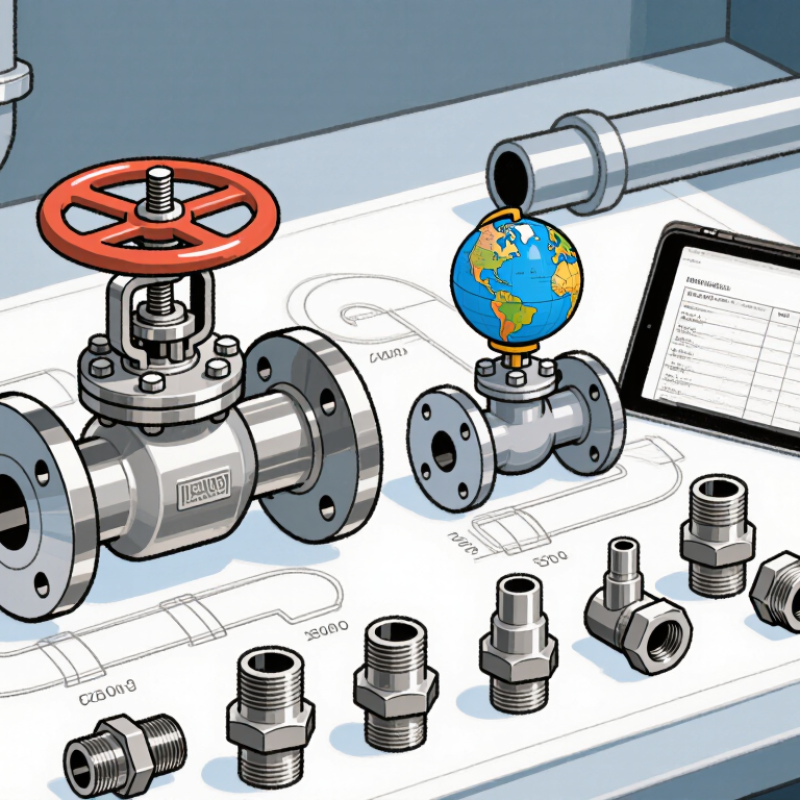
Choose fittings according to the piping function, not appearance. Elbows redirect flow around equipment or walls. Tees create branches for instruments, drains, or process lines. Reducers connect different pipe sizes, while unions simplify future maintenance. In the field, I check thread direction, gasket seating, and available tool clearance before installation. A fitting that fits on paper may still be difficult to service.

Valve design must match the required control. Ball valves provide quick isolation with low resistance. Gate valves suit fully open or fully closed service, but they are poor throttling choices. Globe valves offer better flow adjustment and usually create more pressure loss. Check valves help prevent reverse flow, while butterfly valves can save space on larger lines. Confirm the fluid, temperature, pressure, actuation method, and material compatibility. Small errors can become expensive leaks.

Tips: Mark the flow direction before installing check valves. Leave room for handle movement and actuator removal. Compare pressure-drop data, not only connection size. Test the assembled line gradually. I once focused too much on valve size and overlooked access for maintenance. The line worked, but servicing it was awkward. A perfect selection rarely exists; safe operation, reliable sealing, and practical maintenance should guide the final choice.

Verify Size, Connection Standards, Pressure Ratings, and Control Needs

How to Choose the Right Fittings and Valves?

Choosing fittings and valves starts with accurate size verification. Measure the pipe’s outside diameter, wall thickness, and flow requirements. Nominal size alone can mislead you. A small mismatch may cause leaks, vibration, or difficult installation. I have seen a connection look correct during assembly, then fail after repeated pressure cycles.

Connection standards must match on both sides. Check thread type, flange dimensions, sealing method, and material compatibility. Do not assume similar-looking threads will seal safely. Compare technical drawings and installation records before ordering. Standards vary across regions, and an overlooked conversion can create expensive rework.

Tips: Record every measurement on site. Confirm pressure and temperature ratings from reliable technical documents. Select a valve according to its control need, not only its pipe size. Isolation valves suit on-off service, while regulating valves require suitable flow control characteristics. Consider manual access, actuator space, maintenance clearance, and the fluid’s behavior. A valve rated for pressure may still perform poorly with abrasive or corrosive media. I sometimes prefer a conservative rating, although that choice can increase cost and weight. That trade-off deserves review. Test the completed assembly under controlled conditions, and inspect seals after the first operating cycle.

Compare Installation Methods, Maintenance Demands, and Total Cost

How to Choose the Right Fittings and Valves?

Installation method affects labor, downtime, and future access. Threaded fittings suit small lines and simple repairs. They need accurate sealing and careful tightening. Welded joints offer strength, but they require qualified work and longer shutdowns. Compression fittings install quickly. However, vibration can demand regular inspection. In field audits, the cheapest installation often becomes expensive after repeated retightening.

Maintenance deserves equal weight. The U.S. Department of Energy’s Improving Compressed Air System Performance sourcebook reports that leaks can waste 20–30% of compressor output. Well-maintained systems may reduce losses to 5–10%. That difference can outweigh the original fitting price.

Check valve stems, unions, gaskets, and supports during planned rounds. Look for dust trails, oil marks, or a faint hiss. Small evidence matters.

Total cost includes purchase, labor, energy, replacement parts, and lost production. NIST Handbook 135 recommends discounted lifecycle costing instead of comparing purchase prices alone. A practical worksheet should model service hours, access difficulty, failure frequency, and disposal costs.

Stainless components may cost more initially. They can still reduce corrosion-related maintenance in wet areas. Yet material selection is not always perfect. Over-specification can waste capital, while under-specification can create leaks, safety risks, and unplanned outages.

Choose the connection that technicians can inspect, isolate, and replace without dismantling half the line.

Start WhatsApp Chat Start WhatsApp Chat
Valves

Valves

Water Meters

MS Forged Pipe Fittings

Fittings

Water Meters

Valves

DI Grooved Fittings (UL/FM)

Water Meters

DI Screwed Fittings (UL/FM)

Fittings

Composite Pipes & Fittings

Site Credits : Seigospace