How to Choose the Best Continuous Monitoring Instrument for Your Needs?
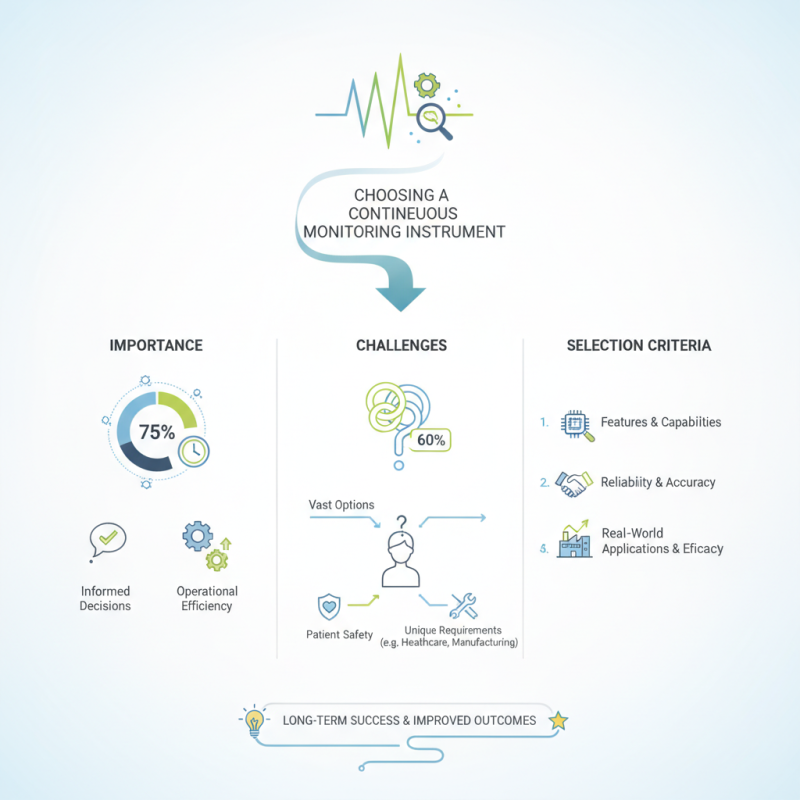
Choosing the right Continuous Monitoring Instrument is crucial in today’s fast-paced industries. A 2022 market report indicates that 75% of organizations rely on these instruments for real-time data analysis. This reliance shapes decisions and enhances operational efficiency. With the right tool, companies can detect issues promptly and improve their overall performance.
However, not all Continuous Monitoring Instruments are created equal. Different industries have unique requirements. For instance, healthcare may prioritize patient safety while manufacturing may focus on equipment maintenance. Knowing what to look for can be overwhelming. A 2021 survey revealed that 60% of professionals find it challenging to select the right instrument due to the vast array of options available.
Understanding the features, reliability, and accuracy of these instruments can make a significant difference. Many tools advertise various capabilities, but not all fulfill these promises. It’s vital to evaluate their efficacy based on real-world applications. A thoughtful approach to choosing the right Continuous Monitoring Instrument is essential for achieving long-term success and improving operational outcomes.
Understanding Continuous Monitoring Instruments: A Comprehensive Overview
Continuous monitoring instruments are vital in diverse industries, providing real-time data to enhance safety and efficiency. These tools help organizations track parameters such as environmental conditions, equipment status, and emissions. Various reports indicate that continuous monitoring can reduce downtime by up to 30%. With accurate data, decision-making becomes faster and more informed.
When selecting a continuous monitoring instrument, consider your specific needs. Look for reliability and accuracy. Understanding the data type you need is crucial. For instance, environmental sensors require different specifications than industrial equipment monitors. Research shows that organizations using tailored solutions see a notable improvement in data accuracy.
**Tip:** Regularly update your monitoring systems to adapt to changing conditions. Outdated tools may affect data reliability. Incorporating user-friendly interfaces can enhance team engagement. Always ensure the technology aligns with your operational goals. Don’t overlook training; it plays a key role in maximizing instrument usage.
How to Choose the Best Continuous Monitoring Instrument for Your Needs?
| Parameter | Description | Examples | Best Use Cases |
| Measurement Range | The spectrum or limits of values the instrument can accurately measure. | 0-100% RH, 0-100°C | Environmental monitoring, HVAC applications |
| Accuracy | The degree to which the measurement result conforms to the true value. | ±0.1°C, ±1% RH | Laboratories, precision environments |
| Response Time | Time taken for the instrument to respond to changes in the measured parameter. | 1 second, 5 seconds | Dynamic monitoring, rapid processes |
| Data Logging Capability | Ability to record measurements over time for analysis. | Internal storage, external data transfer options | Long-term trend analysis, compliance documentation |
| Connectivity | Options for data transfer and integration with other systems. | Wi-Fi, Bluetooth, USB | Remote monitoring, IoT applications |
| Calibration Requirements | Frequency and method of recalibrating the instrument for accuracy. | Annual, bi-annual calibration | Industries requiring strict accuracy standards |
Identifying Your Specific Monitoring Needs and Requirements
When selecting a continuous monitoring instrument, it's crucial to pinpoint your specific monitoring needs. Start by assessing the environment where the instrument will operate. Is it a laboratory, a factory floor, or an outdoor setting? Each location has its unique challenges. Consider factors like temperature, humidity, and potential interference. These elements will affect the instrument's performance.
Next, think about the parameters you wish to monitor. Are you focused on temperature, pressure, or air quality? Narrow down your requirements to avoid confusion. This clarity helps in choosing an instrument well-suited for your application. It's also worth reflecting on how often you need data updates. Continuous monitoring means collecting data in real time. But too frequent updates might lead to data overload.
Budget is another factor to consider. High-quality instruments may come with a hefty price tag. However, cheaper options might compromise on reliability. A balance between cost and quality is essential. Lastly, consulting with professionals can provide valuable insights. They often have experience with various instruments and can guide your decision-making process.
Evaluating Key Features of Continuous Monitoring Instruments
When choosing a continuous monitoring instrument, focus on key features that align with your needs. One critical aspect to consider is the instrument's accuracy. Reliable data collection is essential in any monitoring process. Instruments must be able to provide precise measurements in real time. Inaccuracies can lead to poor decision-making and affect outcomes significantly.
Another important factor is the instrument's ease of use. A user-friendly interface enhances efficiency. Training staff to use complex instruments can be time-consuming and costly. Therefore, look for options that offer intuitive controls and clear displays. The ability to integrate with existing systems is also vital. Instruments that easily connect to other tools streamline data management.
Consider the instrument's durability and maintenance requirements too. Continuous monitoring devices often operate in varied environments. This can include extreme temperatures or humidity levels. Instruments must endure such conditions without frequent breakdowns. Check the warranty and customer support as well. This can indicate the level of confidence a manufacturer has in their product's reliability.
Comparing Different Types of Continuous Monitoring Technologies
When selecting a continuous monitoring instrument, it's crucial to compare different technologies available. Each type offers unique advantages depending on specific needs. For instance, electrochemical sensors are perfect for gas detection. They provide quick response times and are cost-effective. However, they may require regular calibration.
On the other hand, optical sensors can be ideal for particulate monitoring. Their operational principle often includes laser technology, providing high accuracy. However, they may be sensitive to environmental changes, which can affect readings. It’s essential to consider the environment where the instrument will be used.
Tips: Evaluate the maintenance requirements. Some technologies need frequent calibration or servicing, which can lead to increased long-term costs. Also, consider the detection range. Your needs might require a broader scope than what basic models offer. Understanding your specific monitoring needs leads to better decision-making. Test equipment when possible, to gauge performance in real-world conditions.
Making an Informed Decision Based on Cost and Reliability Factors
Choosing a continuous monitoring instrument is critical for operational success. Understanding costs and reliability factors can guide your decision. A recent industry report indicates that 45% of companies face unexpected downtime due to inadequate monitoring systems. This highlights the importance of investing in reliable instruments.
When assessing costs, consider both initial investments and long-term expenses. Instruments with higher upfront costs may save you money through reduced maintenance and fewer failures. The same report noted that reliable systems had a 30% lower maintenance cost over five years compared to cheaper alternatives. This cost-effectiveness often outweighs initial savings from low-quality options.
Reliability is not just a metric; it’s a necessity. Consider metrics like Mean Time Between Failure (MTBF) to gauge the durability of equipment. Instruments with an MTBF of less than 1,000 hours may lead to frequent interruptions. Analyze user reviews and performance data for insights. In an era where consistent monitoring is essential, the right instrument can make all the difference in your operations.