
10 Best Digital Print Socks Manufacturers for Global Buyers

Choosing a reliable Digital Print Socks manufacturer requires more than comparing colorful product photos. Global buyers must examine print clarity, yarn quality, production capacity, sampling speed, and communication. A sharp pattern should remain recognizable after repeated washing. The cuff should recover its shape. The toe seam should feel smooth, not bulky.

Textile printing expert Debbie McKeegan describes digital printing through “speed, flexibility, and control.” This view is especially relevant to custom sock production. Digital printing can support detailed artwork, smaller orders, and faster design changes. Yet, technology alone does not guarantee a dependable supplier. Buyers still need verified material information, realistic delivery estimates, and consistent quality checks.

No factory is perfect. That matters.

A strong manufacturer should explain its limitations clearly. It should identify color differences, artwork risks, minimum order quantities, and packaging details before production. Samples should be tested under practical conditions. Wear them. Wash them. Inspect the heel, toe, elastic, and print edges. These small checks often reveal more than a polished sales presentation.

This guide, “10 Best Digital Print Socks Manufacturers for Global Buyers,” evaluates suppliers from a practical purchasing perspective. It considers customization options, fabric choices, printing methods, order flexibility, export experience, and customer support. The listed companies may serve different markets and price levels. Some may excel at branded collections, while others may suit promotional campaigns or private-label programs. Buyers should still request current quotations and samples before making a final decision. A dependable partnership begins with evidence, not promises.
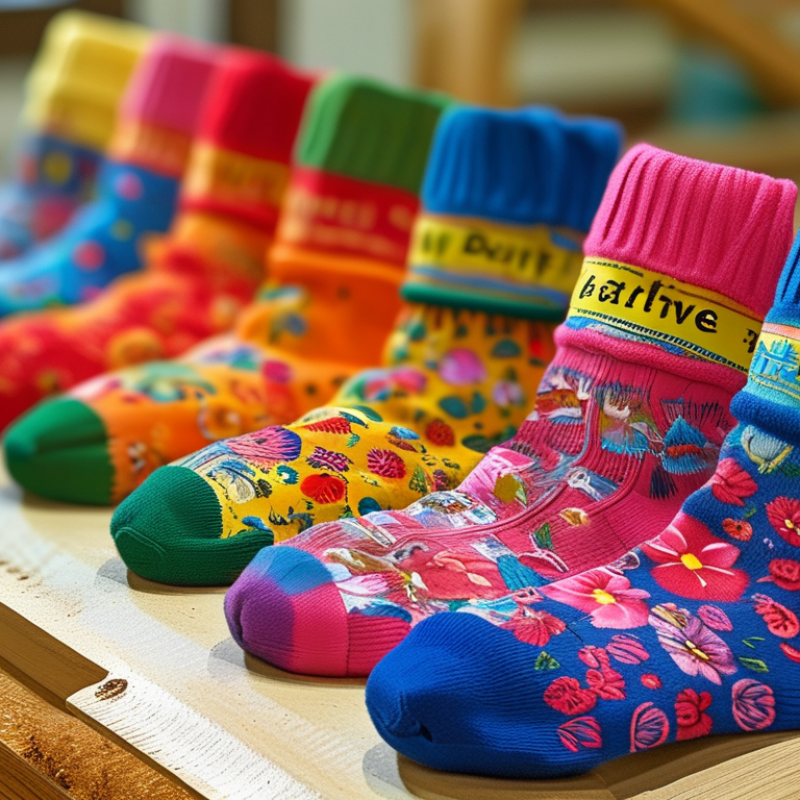
10 Best Digital Print Socks Manufacturers for Global Buyers

Digital Print Socks: Materials, Dye Methods, and Production Technologies

Digital print socks begin with the right fiber, not the printer. Polyester delivers bright color, quick drying, and strong sublimation results. Cotton feels softer against the skin but may produce softer edges. Nylon accepts acid dyes well and supports durable, detailed patterns. Elastane improves stretch, yet excessive heat can weaken its recovery. Material testing should include shrinkage, stretch, rubbing, and repeated washing.

Sublimation dye moves into polyester fibers through controlled heat. It creates vivid images without a heavy surface feel. Reactive or pigment systems suit cotton, but each requires different fixation and finishing steps. Reactive dyes usually need steaming and washing. Pigment printing uses binders and may feel slightly firmer. Small color differences matter.

Digital sock production uses inkjet heads, calibrated software, and precise rotation systems. Good equipment aligns patterns around the heel, toe, and ankle. Uneven tension can still distort a clean design. This happens more often than expected. Experienced manufacturers check color profiles, ink penetration, drying temperature, and seam placement before bulk production. They should provide physical samples, wash reports, and clear tolerances. A sample may look perfect under factory lighting, then appear dull in daylight. That weakness deserves honest review before buyers approve large orders.


Typical Dyeing Temperatures for Digital Print Sock Materials

Fiber selection directly affects digital printing performance. The chart shows representative industrial dyeing temperatures commonly used for major sock materials, helping global buyers compare color fixation requirements and production compatibility.

Typical process values: cotton uses reactive dyes at approximately 60°C, nylon uses acid dyes at approximately 90°C, wool uses acid dyes at approximately 80°C, and polyester or recycled polyester uses disperse dyes at approximately 130°C. Actual settings vary according to yarn construction, dye formulation, machinery, and finishing requirements.

Evaluation Criteria: MOQ, Lead Time, GSM, Certifications, and AATCC 16 Testing

When evaluating the 10 best digital print sock manufacturers, begin with measurable purchasing conditions. MOQ shows whether a factory supports market testing or demands large inventory. A low MOQ is useful, but it may indicate limited production capacity. Ask for the MOQ by color, size, and print design. Small trial orders expose weaknesses.

Lead time should include sampling, approval, production, inspection, and shipping preparation. Digital print socks often need accurate color matching before bulk production begins. Confirm whether the quoted schedule changes during peak seasons. GSM affects warmth, stretch, drying speed, and packaging volume. Request physical samples with recorded GSM readings, not only catalog specifications. Numbers can mislead.

Certifications must match the product’s destination and material claims. Check valid documents, issuing bodies, scope, and expiration dates. A certificate covering yarn may not cover finished socks. AATCC 16 testing is important for evaluating colorfastness to light, especially when bright prints face repeated sunlight exposure. Request the test method, light source, exposure duration, and rating results. In practice, one test cannot predict every washing or rubbing condition. That limitation deserves honest discussion. Keep complete records.

Global Market Context: $5.8 Trillion in 2023 Retail E-Commerce Sales

10 Best Digital Print Socks Manufacturers for Global Buyers

Global retail e-commerce sales reached approximately $5.8 trillion in 2023, according to eMarketer’s global forecast. That scale changes how buyers assess sock manufacturers. Online shoppers expect sharp artwork, dependable sizing, and delivery updates. Small visual defects become obvious on product pages. A poorly aligned pattern can damage reviews quickly.

This list evaluates ten manufacturer profiles through practical buyer criteria. These include digital color accuracy, knitting consistency, minimum order quantity, sampling speed, and export documentation. The Smithers report on digital textile printing also identifies continued growth in short-run, customized production. That trend supports flexible sock sourcing, especially for online sellers testing seasonal designs.

Ask for a physical sample, not only a digital mock-up. Check the toe seam, elastic recovery, wash resistance, and print clarity under natural light.

Details matter.

DHL’s e-commerce research repeatedly highlights delivery visibility and fulfillment reliability as important customer expectations. Buyers should therefore compare production lead times, carton labeling, tracking systems, and replacement procedures. Certifications should be verified against the destination market, rather than accepted from a sales sheet.

A low factory price may hide higher inspection, freight, or return costs. Rankings are never absolute. A supplier with excellent artwork may still lack stable capacity during peak seasons. Even experienced buyers can overvalue a polished sample. A second production check is usually worth the extra time.

Top 10 Digital Print Sock Manufacturers Compared by Capacity and Export Reach

The best digital print sock manufacturers should be judged by production capacity and export reach, not attractive sample images. Smithers’ Future of Digital Print to 2029 identifies textile printing as a continuing growth application, supported by shorter runs and faster design changes. This matters to global buyers ordering seasonal collections.

A strong manufacturer should operate multiple knitting lines, automated printing equipment, and documented quality checks. Monthly capacity figures need careful review. Some factories report theoretical output, not finished pairs ready for shipment. Ask for confirmed capacity, average lead time, minimum order quantity, and defect rates. Small details matter, such as color consistency between cartons.

Export reach is equally important. ITC Trade Map data for HS 6115 helps buyers compare hosiery export activity by country and destination. Wider export experience usually indicates stronger packing, customs, and documentation systems. The WTO’s global trade reports also show how shipping disruptions can affect delivery reliability. A factory serving several regions may offer better route flexibility, but not always lower costs.

Material planning deserves attention. Textile Exchange’s Materials Market Report recorded global fiber production at about 124 million tonnes in 2023, with polyester representing roughly 57%. This scale supports broad yarn availability, yet recycled-content claims still require verification. Request transaction certificates, test reports, and recent shipment references. I would not rank suppliers by capacity alone. Real capacity can change quickly, and published export figures may be incomplete.

Buyer Due Diligence: ISO 105, OEKO-TEX STANDARD 100, CPSIA, and Incoterms

When comparing digital print sock manufacturers, buyer due diligence should begin with test evidence, not attractive product photos. ISO 105 methods help assess colorfastness after washing, rubbing, perspiration, and light exposure. Ask for the exact test method, fabric composition, test date, and laboratory name. A general “ISO tested” statement is too vague.

OEKO-TEX STANDARD 100 documentation should match the sock’s actual materials, dyes, prints, elastic, and packaging components. Check the certificate number and validity through an official verification channel. For shipments entering the United States, CPSIA testing may cover lead, phthalates, and children’s product requirements. Confirm whether the report covers the finished printed sock, not only the yarn. Small details matter.

Request a sealed production sample from the same lot planned for shipment. Compare its color after three washes and inspect the print around the toe seam. Imperfections appear there. A certificate can be genuine yet outdated, incomplete, or unrelated to the final item. This is where buyer judgment matters.

Incoterms should be written beside the named place and shipment year, such as “DAP buyer warehouse, 2026.” Clarify who pays freight, insurance, import duties, customs clearance, and unloading charges. Incoterms allocate delivery responsibilities; they do not prove product safety or quality. Keep invoices, packing lists, test reports, approvals, and inspection photos together. That record supports faster decisions when a shipment is delayed or questioned.

10 Best Digital Print Socks Manufacturers for Global Buyers - Buyer Due Diligence: ISO 105, OEKO-TEX STANDARD 100, CPSIA, and Incoterms

A manufacturer-neutral due diligence framework for comparing digital print sock suppliers without relying on company names or brand claims.

No. Due Diligence Area What the Supplier Should Demonstrate Documents or Tests to Request Buyer Acceptance Benchmark Priority
1 Digital Printing Capability Ability to print detailed artwork on the selected sock construction, including cotton-rich, polyester, nylon, or blended substrates. Production samples, artwork files, stated printing process, wash-test samples, and documented limitations for dark or highly elastic fabrics. The supplier must confirm the compatible fiber content, print method, artwork size limits, minimum order quantity, and expected color variation before sampling. High
2 Color Fastness to Washing Printed colors should resist unacceptable fading, staining, or transfer during laundering. A laboratory report identifying the applicable ISO 105 washing method, test conditions, fabric composition, print recipe, and rating scale. The report should use a recognized ISO 105 method appropriate to the product. Set a purchase-specific minimum rating, commonly Grade 4 or above for color change and staining where commercially appropriate. High
3 Rubbing and Perspiration Fastness The print should show controlled color transfer under dry rubbing, wet rubbing, and perspiration exposure. ISO 105 test reports covering rubbing and perspiration, with separate dry and wet results where applicable. Results should meet the buyer's end-use specification and should be reviewed separately for light-colored garments, dark prints, and high-contact areas such as toes and heels. High
4 OEKO-TEX STANDARD 100 The finished sock or relevant certified component should be tested for harmful substances under the applicable OEKO-TEX product class. A current certificate number, certificate scope, product class, covered components, issuing institute, validity date, and verification result from the official certificate system. The certificate must cover the actual finished product or all relevant components, including yarns, dyes, prints, elastics, labels, and sewing materials where applicable. A supplier declaration alone is insufficient. High
5 U.S. CPSIA Compliance Products intended for children in the United States must comply with applicable limits for lead, specified phthalates, and other regulated substances. Children's Product Certificate where required, third-party laboratory reports, component test records, tracking-label information, and test data linked to the production batch. For applicable children's products, accessible components must meet the current U.S. lead limit of 100 ppm, and regulated phthalates must not exceed 0.1% in applicable accessible plasticized components. Confirm the latest CPSC requirements before shipment. High
6 Fiber and Material Verification The stated fiber composition, yarn count, elastic content, and material construction should match the approved specification. Technical data sheet, raw-material declarations, fiber-composition test, yarn specifications, approved pre-production sample, and batch inspection records. Composition should comply with the destination-market labeling rules and the agreed purchase specification. Any recycled or organic claim should be supported by a valid chain-of-custody document where required. High
7 Dimensional Stability and Fit Socks should maintain acceptable length, width, stretch, cuff recovery, and overall fit after washing. Pre-wash and post-wash measurements, laundering method, shrinkage calculation, size chart, stretch-recovery results, and sample approval record. Agree measurable tolerances before bulk production. The tolerance should cover length, foot width, cuff opening, logo placement, and print distortion after washing. High
8 Quality Control and Traceability The production system should identify raw materials, print batches, knitting lots, inspection results, and corrective actions. Quality manual, inspection checklist, in-line and final inspection records, lot coding, nonconformity reports, corrective-action records, and retention-sample policy. Every shipment should be traceable to a production lot, approved artwork, material batch, inspection result, and packing record. High
9 Packaging and Label Compliance Packaging, fiber labels, care instructions, country-of-origin markings, and children's-product information should match destination-market requirements. Pre-production packaging artwork, label artwork, care-label specification, carton markings, barcode details, and destination-country compliance review. No bulk packaging should be produced until the buyer approves the final artwork and verifies the labeling requirements for each target market. Medium
10 Incoterms 2020 and Shipment Risk The quotation should state the selected Incoterms 2020 rule, named place, transfer point, freight responsibility, insurance responsibility, customs obligations, and delivery schedule. Commercial invoice, quotation, pro forma invoice, purchase contract, packing list, agreed Incoterms rule, named place, freight quotation, and export-document checklist. The contract should use a complete formulation such as “FCA [named place], Incoterms 2020” or “DAP [named place], Incoterms 2020.” Do not treat Incoterms as a product-quality certification; they allocate delivery responsibilities, costs, and risk. High
Buyer note: ISO 105 refers to a family of textile color-fastness test methods rather than a single universal certification. OEKO-TEX STANDARD 100 certificate scope and validity must be checked for the exact product. CPSIA obligations depend on the product, materials, intended user, and U.S. market placement. Incoterms 2020 should always be stated together with a named place.
Start WhatsApp Chat Start WhatsApp Chat
Valves

Valves

Water Meters

MS Forged Pipe Fittings

Fittings

Water Meters

Valves

DI Grooved Fittings (UL/FM)

Water Meters

DI Screwed Fittings (UL/FM)

Fittings

Composite Pipes & Fittings

Site Credits : Seigospace